

vTrust Score™
Every play graded. On the same scale.
Wrap the creative once and every play of it comes back graded, on any network, built only from the verification that was really there.
0
vTrust Score™
Riverside · Mall Walkway
- Harvester · from the glasspresent
- Passport · from inside the adpresent
Fewer layers, lower grade. Never a layer invented to fill the gap.
The gap
Out-of-home has no grade
Credit has ratings. Buildings have energy ratings. Kitchens have hygiene ratings. They work because everyone reads one scale. Out-of-home never got one.
- 01
Every network reports its own way
One sends a playback log. One sends a screenshot. One sends a spreadsheet. None of them agree on what counts as delivered.
- 02
Every screen carries different evidence
Some have a sensor on the glass. Most do not. The same campaign is proved three different ways on three different panels.
- 03
So nothing can be compared
A retail LED, a roadside billboard and a transit screen arrive as three separate stories. There is no scale that puts them side by side.
What vTrust Score is
One number. Every screen. Same rules.
vTrust Score reads the verification layers present on a play, scores them by the same rules every time, and returns one number on four published bands.
Two screens on different networks, sold by different people, measured by different means, land on the same scale. Nothing in out-of-home does that today.
See it work
One campaign. Three plays. Three grades.
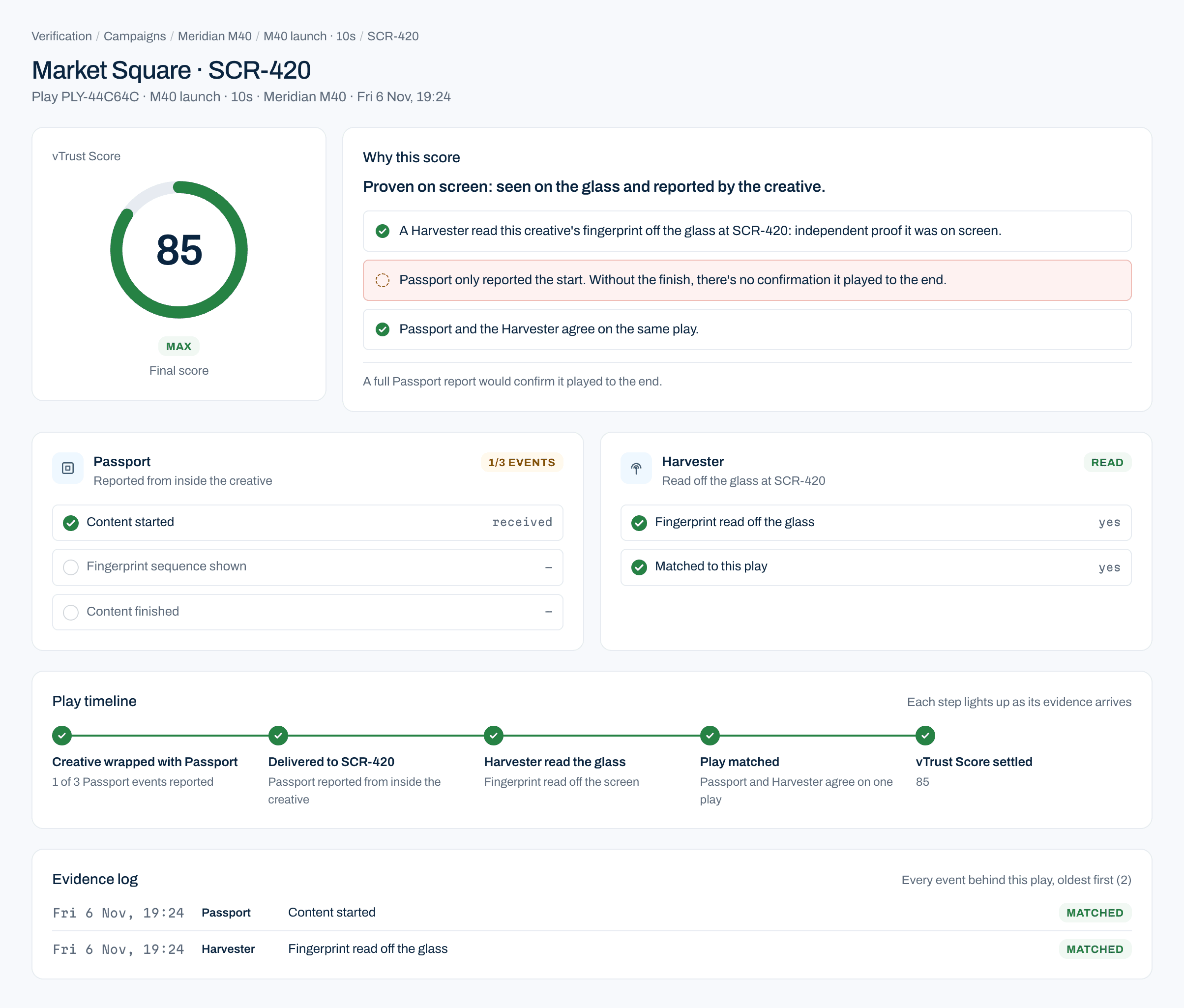
Each play is graded from the evidence it carried, not the screen it ran on. Switch between them: the gap between the numbers is evidence, not opinion.
What goes in
It grades only what was there
More layers present means a deeper vTrust Score. Missing layers stay missing.
When a Harvester is fitted, Proof of Display from the glass joins the play. A play the Harvester matched on the glass is the only kind that can reach MAX.
When it isn’t, that layer stays empty. The score still counts Passport's proof and anything else present. It will not invent Proof of Display, so the play stays below MAX.
Creative enters through Passport. Glass Proof of Display comes from Harvester, which always ships with Passport.
Passport only
The ad reports from inside itself that it played.
- Passport · inside the ad
Up to HIGH
Tops out at 70. The glass is never guessed at.
Passport + Harvester
And a sensor confirms it actually appeared on the screen.
- Passport · inside the ad
- Harvester · on the glass
Up to MAX
Proof of Display from the glass is the only way into MAX.
The scale
Higher means more evidence
vTrust Score runs 0 to 100. It measures how much verification was present on that play and nothing else. It is not a quality rating for the panel, and it is not a verdict on the buy.
- 75 to 100MAXHarvester matched
A Harvester watched that screen and matched the play. The one thing a player cannot self-report, and the only way into this band.
- 50 to 74HIGHStrong content evidence
Passport reported the play from inside the creative’s own render. Real evidence, from the creative rather than the glass, so it stays below MAX.
- 25 to 49MEDIUMPartial evidence
Passport saw the creative start, but the rest of the play was not confirmed. Something ran; less of it was proved.
- 0 to 24LOWLittle was present, or the glass disagreed
Almost no evidence attached, or the glass contradicted it: Passport reported the play, but the screen was dark or showing something else. Otherwise a matched play always scores above this band, and a low grade is not a bad panel, just a play you know little about.
These are the bands the scoring engine itself uses, and every play’s score is versioned against them. Without a Harvester match a play never reaches MAX, however complete the rest of the evidence.
Your bar
We send the score. You decide what is good enough.
Vojo never sets a pass mark. Two buyers can hold different bars without the number meaning anything different. Here is how buyers typically turn the scale into one.
Proof-critical buys
Ask for MAX (75 and up)
Where a client will audit delivery, or the panel is the headline of the plan. Only plays a Harvester matched on the glass clear it.
General brand buys
HIGH (50 and up) is usually enough
A complete Passport report lands in HIGH on any network, without demanding a sensor on every screen you buy.
Trading and make-goods
Use your bar as a trigger
Plays under threshold can be flagged, re-run or credited. Both sides of that conversation are working from the same number.
The whole chain reads the same number. Buyers compare across networks without pretending every screen has glass proof. Networks show the strength of the inventory they instrumented. Exchanges and platforms gate, rank or report against a score built from evidence on the play, not a seller claim.
See your own campaign graded on one scale.
Other ways to do this
What people compare it to
Most of the market grades nothing today. Here is what buyers use instead, and where each holds up.
The operator's own playback report
A log exported from the CMS saying the campaign was dispatched to the loop.
Where it is fine
Where you already trust the seller and nobody downstream is auditing the numbers.
Where a grade differs
It is the seller's account of their own delivery, and it records what was sent, not what appeared. A grade says which of those you are looking at.
One verification vendor's pass or fail
One measurement partner marks each play verified or not verified.
Where it is fine
When every screen on the plan carries that vendor's coverage.
Where a grade differs
A binary flattens a fully instrumented screen and a barely instrumented one into the same word. A graded score keeps the difference visible.
Nothing, and the relationship
Trust built over years of trading, settled by conversation when something looks wrong.
Where it is fine
Between people who have dealt with each other for a long time.
Where a grade differs
It does not survive scale, staff turnover or a procurement process that asks for evidence. And it gives you nothing to price against.
Questions
Before you book a demo
- What is vTrust Score?
- vTrust Score™ is a grading system for out-of-home. It reads every verification layer that was actually present on a play and turns them into one number, using the same rules every time, so screens on different networks can be compared on one scale.
- How does it relate to Passport and Harvester?
- Passport proves each wrapped play from inside the ad. Harvester adds Proof of Display from the glass when fitted. vTrust Score reads whichever were present into one score: wrap the creative with Passport once and every play of it comes back graded.
- Can I use the score without Harvester everywhere?
- Yes. Plays without a Harvester still score from the layers that are there, but never into MAX (75 and up). Proof of Display only counts when a Harvester on that screen matched the play; if none is fitted, that layer stays empty. The score does not invent glass credit.
- Does a lower score mean a worse screen?
- No. It means less verification evidence was attached to that play. A strong screen with no Harvester fitted carries Passport's proof only and will grade lower than the same screen with glass proof on it. The number describes the evidence, not the panel.
- Who decides what a good score is?
- You do. Vojo produces the grade and never sets the threshold. A premium retail buy and a broad awareness buy can reasonably demand very different numbers from the same scale, and the score means the same thing in both.
- Is vTrust Score an accredited industry standard?
- No, and we do not claim it is. It is Vojo's grading system, with the bands published and every play's score versioned, so a number can always be traced back to the rules that produced it. Accreditation is a separate process run by other bodies. We would rather be openly checkable now than quietly imply an approval we have not been given.
The grade out-of-home never had.
One scale for every play, on every screen your creative lands on, built from the layers that were really there. Passport on every wrap. Harvester where you fit it. Nothing invented to fill a gap.